
The Regenexx Difference- A Medical Practice with More than a Push Button Centrifuge
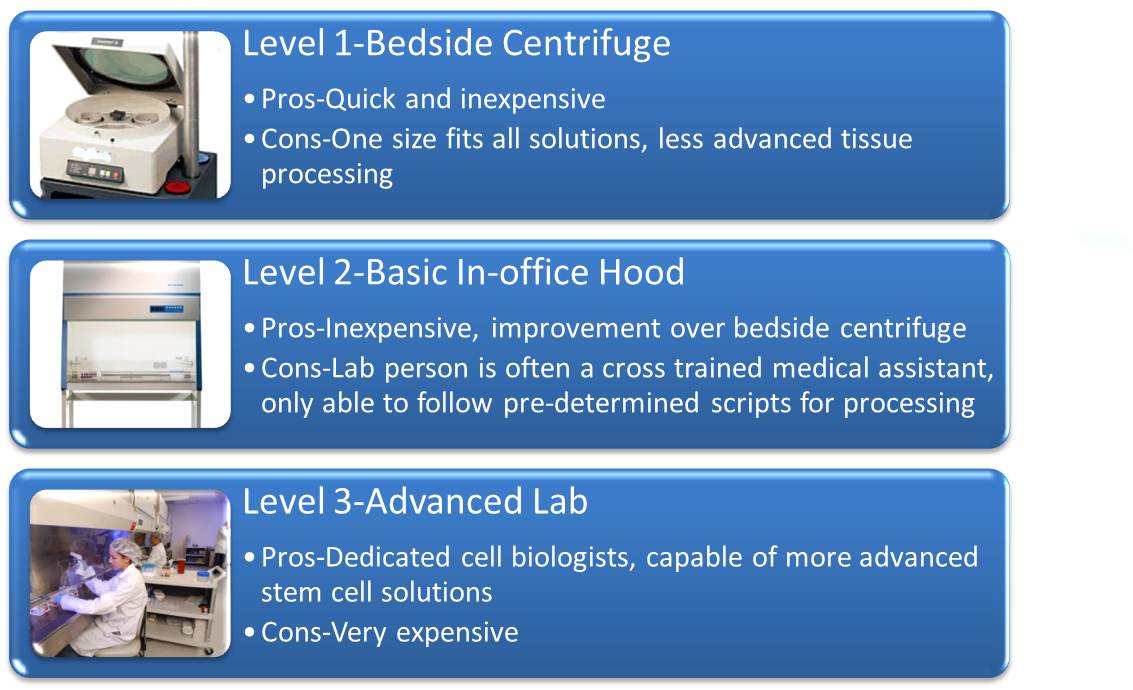
Medical practices that offer stem cell therapies fall into three distinct categories, levels 1-3 (see above). At the most basic level, the practice uses an off the shelf, bedside centrifuge to spin down samples. This is the same type of machine that produces PRP (platelet rich plasma). The advantage of this type of simple set-up for stem cell procedures is that it’s inexpensive for the doctor to get started. The downside is that it produces a much less sophisticated stem cell concentrate than could be produced by a cell biologist. At this same level of sophistication are other bedside kits being used to process cells at the bedside or in an operating room without a sterile hood. We have serious concerns about this type of processing, especially for fat tissue, as it’s often not processed in an adequate safe environment (like a biologic safety cabinet or “hood”), but instead by a medical assistant working on an open table in a patient room.
The next level of sophistication up is a level II procedure, or a basic “in-office” hood. The advantage is that while a bit more costly, there’s an actual person processing samples. All of the Regenexx Network providers have these more advanced set-ups rather than push button bedside centrifuges.
The third type of stem cell therapy setting is a level 3 Advanced Lab. This is staffed with dedicated cell biologists and has advanced capabilities such as cell culture, flow cytometry, phase contrast microscopy (the ability to see and count cells without having to harm them by staining), fluorescent microscopy, ELISA, qPCR, cryo-preservation (the ability to bank cells and save quality assurance samples) etc… Not only can a higher quality cell based procedure can be performed, but varied procedures can be offered to best meet the need of the patient. In addition, things like checking the viability of the cells and the doctor’s harvest and re-implant procedures can easily be accomplished.
The Centeno-Schultz clinic has always used a level III lab facility with dedicated cell biologists rather than bedside centrifuges. The reason is that this allows us to offer patients the highest quality stem cell procedures and adjust the patient’s cell sample to meet their needs. While this is dramatically more costly than bedside centrifuges, we believe the additional cost creates better stem cell solutions.
If you have questions or comments about this blog post, please email us at [email protected]
NOTE: This blog post provides general information to help the reader better understand regenerative medicine, musculoskeletal health, and related subjects. All content provided in this blog, website, or any linked materials, including text, graphics, images, patient profiles, outcomes, and information, are not intended and should not be considered or used as a substitute for medical advice, diagnosis, or treatment. Please always consult with a professional and certified healthcare provider to discuss if a treatment is right for you.