

Hip: Anatomy, Medical Conditions, And Regenerative Care
Are You a Regenexx Candidate?Hip Anatomy And Its Role In Movement
The hip is a strong and flexible joint that connects the leg to the body. It works like a ball and socket, letting the leg move in many directions while supporting body weight. As the second-largest joint in the body, the hip helps with everyday activities like walking, running, and jumping.
Because the hip supports so much weight, injuries can often cause pain, even if they are minor. Several parts of the hip work together to allow smooth movement. When these structures become injured or worn, it can lead to discomfort or make it harder to move. In some cases, stiffness or a smaller range of motion may be the main symptom, which can make daily activities more difficult over time.
Bones
The interaction of two primary bones forms the hip joint. The “ball” is the head of the femur (the thigh bone), which fits into the “socket,” a cup-shaped structure in the pelvis called the acetabulum. The health and alignment of these bones are fundamental to the joint’s stability and function.
Muscles
Numerous muscles surround the hip, enabling movement in various directions and providing crucial stability. Major muscle groups include the gluteal muscles at the back, the hip flexors at the front, the abductor muscles on the outside, and the adductor (groin) muscles on the inside of the hip. Injury or weakness in these muscles can lead to pain and gait problems.
Ligaments and Connective Tissue
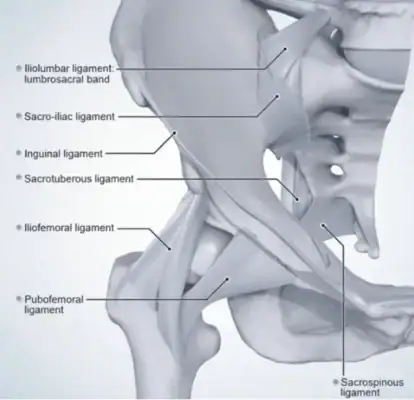
Strong ligaments form a dense network around the hip, connecting the femur to the pelvis and creating the joint capsule. This capsule encases the joint and holds lubricating fluid (synovial fluid). These tissues are vital for reinforcing the joint and limiting excessive movement. Additionally, tendons connect the surrounding muscles to the bones, transferring force to create motion. Strains or tears in these connective tissues can compromise joint stability.
Cartilage and Labrum
The surfaces of the ball and socket are covered with a smooth substance called articular cartilage. This tissue allows the bones to glide against each other with minimal friction. Around the edge of the hip socket is a special ring of fibrocartilage called the labrum, which deepens the socket to enhance stability and acts as a seal. Damage to either the articular cartilage or the labrum from injury can be a significant source of hip pain and may lead to conditions like osteoarthritis (a type of joint damage).
Can Hip Conditions Be Treated Without Surgery?
While surgery is a common recommendation for significant hip conditions, non-surgical options are available. For hip pain caused by an injury or a degenerative condition, interventional orthopedic procedures—such as those using Regenexx injectates— may help reduce discomfort and support the body’s natural healing processes. Because these procedures are less invasive than surgery, they may also offer the potential for less downtime and reduced risk and discomfort compared to surgical options.
| Regenexx SD Injectate | Surgery | |
|---|---|---|
| Return to Daily Routine | 2 to 5 days | 6+ weeks |
| Return to Sports | 3 to 6 months | 1 year |
| Recovery | Brace, up to 6 weeks PT | Crutches, brace, extensive, no driving, 3 to 6 months PT |
| Pain Management | Mostly over-the-counter pain medication (days) | Prescription pain medication for weeks (weeks) |
| General Anesthesia | No | Yes |
| Keep Your Hip Joint | Yes | No |
Hip Conditions That May Benefit From The Regenexx Approach
The hip joint can be affected by both acute injuries and chronic conditions that develop over time. While a broken hip bone (fracture) usually needs surgery, many other hip problems may be treated without it. This includes injuries to the tendons, ligaments, or muscles around the joint. Conditions like osteoarthritis, which develop slowly over time, can also cause hip pain and limit movement. Some of these problems may be treated with non-surgical procedures, like those offered by physicians in the licensed Regenexx network..
Physicians commonly evaluate patients with the following hip conditions:
- Hip Labrum Tears: A hip labrum tear occurs when the ring of fibrocartilage surrounding the hip socket is damaged due to injury or degeneration. It may cause hip pain, stiffness, clicking sensations, and instability, often worsening with movement or prolonged activity. Read More About Hip Labrum Tears.
- Hip Tendon Tears: Hip tendon tears occur when the tendons around the hip joint partially or fully rupture due to injury or degeneration. This may cause pain, weakness, and reduced mobility, often worsening with movement or prolonged activity. Read More About Hip Tendon Tears.
- Hip Osteoarthritis: Hip osteoarthritis occurs when the cartilage in the hip joint gradually wears down, leading to pain, stiffness, and reduced range of motion. Symptoms may worsen with movement or weight-bearing activities, potentially affecting mobility and daily function. Read More About Hip Osteoarthritis.
- Hip Osteonecrosis: Hip osteonecrosis occurs when reduced blood flow to the femoral head leads to bone tissue death, potentially causing pain, stiffness, and joint instability. Symptoms may worsen over time, affecting mobility and increasing the risk of hip joint collapse. Read More About Hip Osteonecrosis.
- Acetabular Cyst: An acetabular cyst is a fluid-filled sac that develops within the hip socket (acetabulum), often due to joint degeneration or cartilage damage. It may contribute to hip pain, stiffness, and reduced mobility, potentially affecting daily activities and movement. Read More About Acetabular Cyst.
Patient’s Results
The Regenexx Provider Patient Registry is used to track patient outcomes and any reported side effects following procedures. For patients treated for hip injuries under Regenexx protocols, reported data includes:
How The Regenexx Approach May Help With Hip Injuries
Procedures using Regenexx injectates are a non-surgical alternative that uses advanced image guidance to precisely place a patient’s own bone marrow concentrate, which contains healing agents, into the specific area of injury within the hip joint structure.[1-2]
These injected agents work with the body’s natural healing process. This approach may help support the stability of the hip joint, which may help regain function and mobility.[3]
Get started to see if you are a Regenexx candidate
To talk one-on-one with one of our team members about how the Regenexx approach may be able to help your orthopedic pain or injury, please complete the form below and we will be in touch with you within the next business day.
References:
- Centeno CJ. Efficacy and Safety of Bone Marrow Concentrate for Osteoarthritis of the Hip; Treatment Registry Results for 196 Patients. J Stem Cell Res Ther 2014;04(10). doi:10.4172/2157-7633.1000242.
- Friedlis MF, Centeno CJ. Performing a Better Bone Marrow Aspiration. Phys Med Rehabil Clin N Am. 2016 Nov;27(4):919-939. doi: 10.1016/j.pmr.2016.06.009. PMID: 27788908.
- Centeno CJ, Kisiday J, Freeman M, Schultz JR. Partial regeneration of the human hip via autologous bone marrow nucleated cell transfer: A case study. Pain Physician. 2006 Jul;9(3):253-6.